
Chat with us
+256 782 837 536
Give us a Call
+256 704 858 623
Location
Gadaffi Mosque, Kampala
best time to visit Uganda

What is the best time to visit Uganda?

Uganda is a destination that can be visited all year round but also depends on what you are going to do on your Uganda Safari adventure.
Uganda lies on the equator and has a warm sub-tropical climate, day time temperatures average between 25 and 29c, night time temperatures frequently drop below 20c offering a nice reprieve on hot days.

Uganda is a fast-growing African safari destination that’s lately getting significant attention from the leisure travel world. Equatorial Uganda has a pleasantly warm and tropical climate with significant seasonal variations.

There are wetter months that make certain plans and activities difficult which need prior planning before you come to Uganda.
The other factor making Uganda a better travel destination throughout the year is Lake Victoria and its unique weather patterns.

Uganda has mainly two rainy seasons normally the long season which starts from mid-March to the end of May and the short season which starts from October to November.
The average temperatures of Uganda are 21.5C and 71 C and these also drop at night time to around 54 F which affects the altitude.
Rainfall in Uganda ranges between 1000-2000 mm every year. However, throughout the year the skies in Uganda are clear which makes it the best safari destination for your perfect Uganda holidays.

Also, the climatic changes have brought about changes in the weather patterns hence making it hard to predict the best travel times to Uganda.
Therefore, the best times of the year when you should visit Uganda are in the dry months of June, July, August, September as well as January and February. Like the rest of Africa, It’s important to put it in mind that the country has two dry seasons and two wet seasons. Each of these seasons has its own charm and offers visitors a unique experience of the natural beauty of the country.
Another factor in planning your vacation is the particular tours and safari activities you wish to participate in.

Most travellers choose to travel from May to September and February since in these months the amount of rainfall has reduced and it is sunny in most destinations.
December is one of the busiest months of the year for both international and domestic tourists. This is the month of festival seasons so the majority of the people are getting their holidays and honeymoons hence making many tourist destinations busy.

It is advisable to book your accommodations and activities on time to avoid disappointments.
Visiting in low seasons is also ok for many tourists since accommodations are cheap and not Congested, and the transport wages are not too high as compared to high seasons. Visiting in this season also means that you will enjoy the jungle and its attractions with relatively low crowds.
February and September are also recommended months for a safari vacation in Uganda since there are few travellers coming and the lodges are not fully booked compared to the high seasons.

The rainy season: The rainy season affects people’s travels but doesn’t mean that they don’t travel. They travel because the season is also combined with rainfall and sunshine. This means the sun comes out immediately after the rain stops, the tourist activities like game drives, nature walks, and boat cruises among others are able to be carried out without any disturbances.
Gorilla and chimpanzee trekking tours can as well go on during the rainy season and the National parks are fully in operation.
Also, during the rainy season also known as the low season, the lodges reduce prices to attract more travellers to book with them which is an added advantage. The gorilla and chimpanzee trekking permits also are reduced to attract more visitors to Uganda.

The dry season: Uganda has got raised topography, which means that its climate is cool making it easy to plan your Uganda safari vacation all year round. However, if you are planning to come for your Uganda gorilla trekking tour, it’s important to notice the easiest trekking conditions despite the low rates in the low seasons. So, this means the best time to come for gorilla trekking is during the two dry seasons of January and February and from June to September. Game viewing, hiking and nature walks in all National parks of Uganda are best done in the dry season from February and March, June to August and the beginning of September. This is because around this time, the wildlife species are concentrated around the water bodies within these parks.
Bird watching is also best carried out between November and April for the birders when the migratory birds are present in the country but can also be done throughout the year to enjoy their safaris in Uganda. Additionally, if you are thinking about visiting other National parks and game reserves in Uganda like Queen Elizabeth National park, Murchison Falls National park, and Lake Mburo National park you might want to choose the shorter dry season of January and February or the longer best dry season of June, July and August. The vegetation in these parks is sparse during this time of the year, locating wildlife is easier and the roads are less muddy making travelling to these areas less time-consuming.

However, if you are planning to visit the urban areas for a Kampala city and slum tour experience or Entebbe City tour, you will find the weather having minimal effect on your city tour activities and you can continue with your excursions at most times of the year.
In contrast to the rest of Uganda, Kidepo valley National park has one long dry season from July to February and one wet season from March to June. Each of these seasons offers a unique aspect of superb beauty of this region. In the dry season, most of the wildlife gathers near the watering holes of the Narus River valley system, making it easy to locate the animals during your game drive safaris. There are also great opportunities to see the seasonal Kidepo River flowing before it seems to disappear during the dry season.
Some key takeaways to note as you plan your next tour to Uganda;
Mountain gorillas tend to be on lower elevations during the wet seasons since they do not have to travel far looking for food while during the dry season, they traverse higher elevations in search of food. Temperature variations across the country depend on locations and altitudes. High land temperatures tend to be lower all through the year, with nighttime weather getting even cooler. Having your travels in the wet season is typically more economical than during the dry season.
Guide to Gorilla trekking in Uganda

Guide to Gorilla trekking in Uganda

GUIDE TO GORILLA TREKKING IN UGANDA

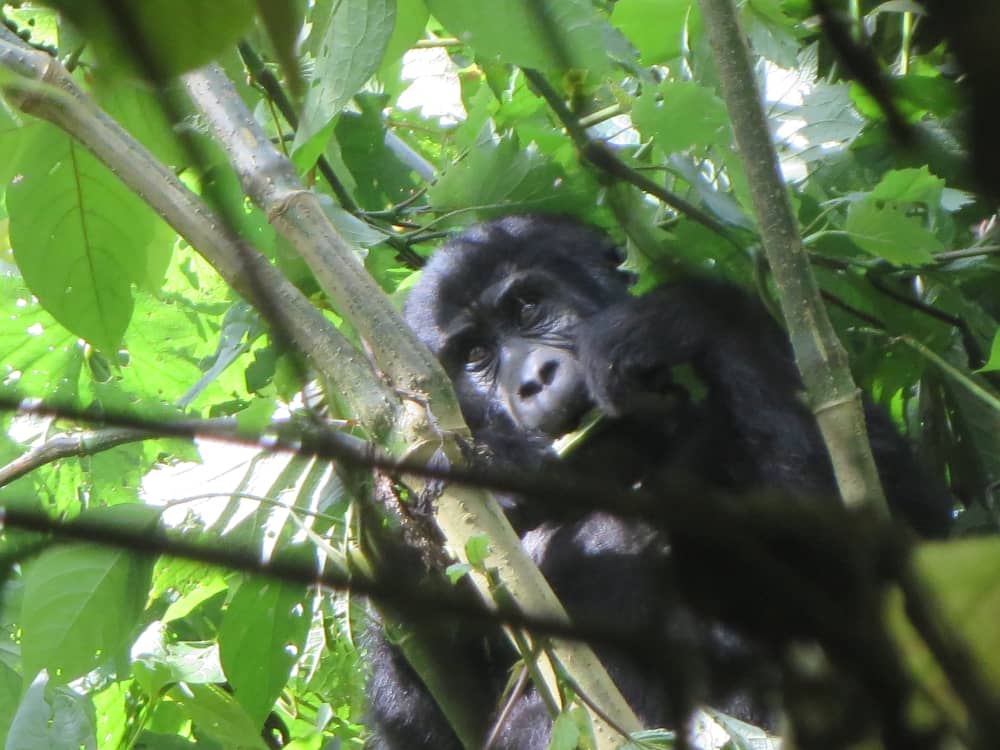
This Mountain Gorilla trekking guide to Uganda provides information about Mountain Gorillas which are an endangered primate species that can only be found in the Forested areas of the Virunga Massif stretching from Uganda, Rwanda to DR Congo. In Uganda, there are two protected national parks where you can see the endangered mountain gorillas; Bwindi Impenetrable Forest National Park and the Mgahinga Gorilla National Park both located in southwestern Uganda.

The current mountain gorilla global population stands at about 1,063 individuals, half of which are found in Uganda. Gorillas are gentle Giants and are closely related to humans since they share up to 96% of their DNA composition with Humans. Unlike the lowland Gorillas, the mountain gorillas have never been able to survive in captivity and therefore no mountain gorillas are found in Zoos outside of Africa.
Guide to Gorilla trekking in Uganda
Gorilla in Bwindi Forest

Gorilla Tourism and Conservation

To see the Mountain gorillas, you must come to Uganda, Rwanda or the Democratic Republic of Congo and trek through the dense tropical rain forests the Mountain gorillas call home. In the late 1960s-80s, the Mountain gorilla population reduced drastically due to poaching, disease, civil wars and encroachment of the gorilla habitat by Humans. However, with efforts through Gorilla Tourism and Conservation, with the creation of protected areas and national parks, the mountain gorilla population has been increasing steadily over the years. In the 1990s, the protected areas were opened up for Gorilla tourism and some of the mountain gorilla families were habituated to allow tourists to trek them. At the moment, there are close to 20 habituated mountain gorilla families in Uganda, which are all available for tourists to visit.

Gorilla trekking permit

In order to visit the Gorillas, you are required to purchase a Gorilla trekking permit and this has to be done in advance to ensure that your slot is guaranteed. The gorilla trekking permit can be purchased through a local tour operator, or directly through the Uganda wildlife authority if you are already in Uganda. The Uganda gorilla trekking permit costs $800 dollars for foreign nonresidents, $700 for foreign residents, $500 for Rest of Africa and Shillings 3o0,000 for East Africans. The Uganda gorilla habituation Experience Permit Costs $1,500 dollars for foreign nonresidents, $1,000 for foreign residents, $1000 for Rest of Africa and Shillings 750,000 for East Africans which money greatly helps with the Gorilla conservation. The government of Uganda uses proceeds from the sale of gorilla trekking permits to further conservation and intervention efforts as well as building infrastructure.

The local communities also receive a percentage of this money through the Uganda wildlife Authority, as well as allocation by the government to the local governments in areas where the national parks are found. Therefore, by coming for Gorilla trekking in Uganda, you greatly impact the conservation of these great species of primates.

When to Visit the Gorillas

Gorilla trekking can be done all year round, however, the most recommended period is during the Dry season months of June, July, August, September, December, January and February. During this period, there is very little rainfall and therefore the conditions are conducive for hiking through the densely forested landscapes of Bwindi Impenetrable National Park and Mgahinga Gorilla National Parks.

You can combine your Uganda wildlife safari with a Gorilla trekking Safari to the mountain Gorillas and visit other national parks within Uganda for an authentic African wildlife experience. Other popular national parks in Uganda are Murchison falls national Park, Kibale Forest National Park, Queen Elizabeth National Park, Kidepo Valley National Park and Lake Mburo national park, Semuliki National Park, Rwenzori Mountain National Park, Mt. Elgon National Park.

Gorilla Trekking in Uganda, Vs Rwanda, Vs Congo

The only three countries in the world where you can see the mountain gorillas are Uganda, Rwanda and DR Congo. However, visiting the Gorillas in Uganda is more recommended than gorilla trekking in Rwanda or DR Congo because of two main reasons, the permit price in Uganda is $800 while the Rwanda Gorilla trekking permit costs $1500 for the same experience! This makes Uganda the better option as compared to Rwanda.

On the other hand, the DR Congo Gorilla permits cost only $400. However, due to civil wars and guerillas near the Virunga national park, it is not safe and therefore Uganda is still better than Congo as your security while on a gorilla safari is guaranteed unlike in Dr Congo’s Virunga.

Accommodation and transport

There are a lot of accommodation options near Bwindi Impenetrable National Park and Mgahinga gorilla national park. These range from Camping, basic budget, Average to luxurious lodges and therefore, every tourist is sorted based on their Budget. As for transportation you can reach Bwindi Impenetrable National Park by road or fly, Charter with internal flight providers. Accommodation, Transport and Gorilla permit booking can all be arranged for you by MuAfrika Adventures Limited.

another gorilla born in bwindi impenetrable forest

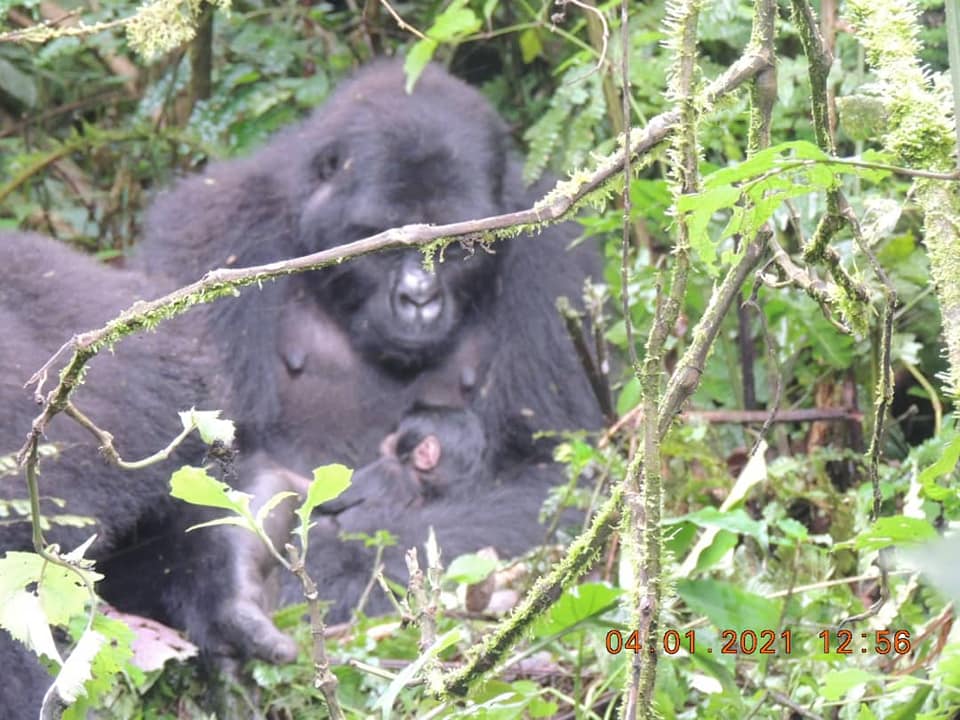
Happy gorilla year 2021! The new year brings another gorilla baby Bwindi Impenetrable forest fold! On January 4th, Nkuringo family’s Adult Female Nderema gave birth to a new baby bringing the family size to 12 members. The new birth marks Nderema’s second infant following her first birth in 2018 that saw her baby sadly not make it due to environmental extremes within its first 15 days of birth.

“We have another gorilla baby Bwindi Impenetrable Forest (BIF) fold!” revealed Gessa Simplicious.
“The good news happened January 4th, to the Nkuringo family where an adult female called Nderema gave birth. This brings the number of newly born little ones to 12 members.”
The new birthmarks Nderema’s second baby following her first birth in 2018. Unfortunately, the first baby died after 15 days.

“You should have seen the mood among the group members when the baby passed on,” recounts Gessa. “They declined to eat and the forest lacked the hoots and banging of tree barks as it is usually.”
Fortunately, gorilla trackers are slowly trickling back to Bwindi impenetrable Forest National Park and are expected to increase given the prevailing discounts.
“Uganda is globally the cheapest place one can track these endangered Mountain Gorillas found only in Rwanda, DR Congo and Uganda,” noted Uganda Wildlife Authority (UWA) executive director Sam Mwandha.
“Given the peace, cultural diversity, birds, mammals and reptiles – it is irresistible.”
The Minister of State for Tourism, Geoffrey Kiwanda sums up saying after having Bwindi impenetrable Forest National Park connected to social media, it is every tourist’s dream destination.
“There are bonuses like meeting the Batwa, seeing more than 250 mountain birds, organic fruits and lots of food to whet any appetite,” stressed Kiwanda.
He added, “There is no need to see guests off with a “Come Again” farewell because they have to come back for some more.”